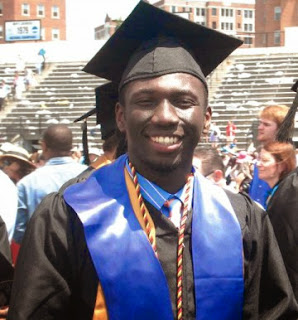
Nigerian Breaks Academic Record At John Hopkins
University
A 22-year-old Nigerian has emerged one of the top
graduating students of John Hopkins University in the United
States. He obtained a Grade Point Average of 3.98 out of a
possible 4.0 to earn a degree in Neurosciences, SEGUN
OLUGBILE writes.
A 22-year-old Nigerian, Emmanuel Ohuabunwa, has made
history at John Hopkins University, United States of America.
Ohuabunwa from Arochukwu, Abia State, has done the
nation proud by becoming the first black man to make a
Grade Point Average of 3.98 out of 4.0 to bag a degree in
Neurosciences in the university. He was also adjudged as
having the highest honours during the graduation that was
held on May 24 this year.
For his efforts, he has won a scholarship to Yale University
to pursue a degree in medicine. Besides, he has been
inducted into Phi Beta Kappa Society, a prestigious honour
group that features membership of 17 US Presidents, 37 US
Supreme Court Justices, and 136 Nobel Prize winners.
According to Wikipedia, The Phi Beta Kappa Society is an
academic honour society. Its mission is to "celebrate and
advocate excellence in the liberal arts and sciences" and
induct "the most outstanding students of arts and sciences at
America's leading colleges and universities."
It was founded at The College of William and Mary on
December 5, 1776, and thus it is the oldest honour society
for the liberal arts and sciences and among the oldest
undergraduate societies in the US.
In an online interview with our correspondent, Ohuabunwa,
who was born in Okota, Lagos and attended Lilly Fields
Primary School, Lagos, said he left Nigeria after his junior
secondary school education at Air Force Comprehensive
School, Ibadan, Oyo State.
"My parents moved the whole family when I was 13 years
old. I was about to begin SS1 at Air Force, Ibadan. When I got
to the US, I was enrolled with my age mates, which meant at
13, I was in middle school. I went to Fondren Middle School,
which was in the middle of the ghetto. That was one of the
darkest years for me because I encountered a lot of peer
pressure. Some of the students, ignorant about Africa,
bullied me and called me names such as 'African booty
scratcher' because to them, Africans were dirty and
scratched their butts all the time.
"Some asked me if I lived in mud huts and ate faeces for
breakfast. I remember one day, when I was walking to the
school bus, a boy came from behind and punched me in the
face, called me an African and walked away. It took
everything in me not to retaliate. I knew that God had put
me in the U.S for a purpose and it did not involve fighting or
selling drugs or doing the wrong things.
"My experience during that year gave me a thick skin. I
learned to stand for what I thought was right even when the
opposition seemed insurmountable. I also learned to look at
the positive in all situations. Even though these kids were
bullying me, I was still gaining an opportunity to school in
America and nothing would stop me from making the best of
this opportunity.
"The shocker was that the kid that punched me in the face
was black. I would have expected the blacks to be nicer to
me. Nevertheless, I don't blame those kids because they
were ignorant about Africa. All they knew about us was the
stuff they had watched on TV or documentaries, showing
primitive African tribes, living in the jungle and making
noises like monkeys.
"In regards to the whites, there might have been some
minor episodes but again I don't blame them for it because
it is a problem with stereotypes," he said.
But in spite of this humiliation and racial prejudice against
him, the first in a family of three was not discouraged. He
faced his studies and was always coming top in his class.
After he completed his middle school education, he passed
the entrance examination to DeBakey High School for Health
Professions. It was at this school that his interest in
neurosciences and medicine started.
"By the second year of high school, we were able to interact
with doctors, nurses and other administrators in the
hospital. The more I learned about medicine, the more it felt
like the thing God was calling me to pursue and by being in
the US I got a lot of people to support me to do this. Even
though in high school, I got to see first-hand what it meant
to be a doctor. We studied advanced anatomy and
physiology, learned medical terminology, and learned
important skills, such as checking blood pressure, pulse
rate, and many more.
"I knew I wanted to go to the best school in the US. I had
heard that Johns Hopkins Hospital had been ranked the
number one hospital in the US for the past 21 years and I
wanted to be in that environment.''
Worried that his parents might not be able to sponsor him
to the university, Ohuabunwa purposed to work very hard.
He did and when the result of the PSAT came, he performed
so well that he won the National Achievement Scholar.
By virtue of this award, he received certificates of
recognition from various organisations including senators
from the Congress of both Texas and the US. He also
received scholarship from the University of Houston; Rice
University, Texas A&M Honors College and many more.
He had also won the Principal's Award during the annual
awards ceremony at DeBakey High School.
"During our graduation ceremony at DeBakey, I also won the
Award for the Most Outstanding Senior Young Man and the
student volunteer award for my volunteer activities in the
State of Texas," he said.
But his breakthrough came when he won the Bill and
Belinda Gates Foundation full scholarship to any university
of his choice. He worked hard and gained admission to
Johns Hopkins University to study Neurosciences.
But why Neurosciences, Ohuabunwa said, "I studied
Neuroscience, because I was fascinated with the brain, its
control of our behaviours and how various diseases such as
Alzheimer's disease, lead to a decline in its activity. I also
minored in Psychology because I wanted to understand
disorders in the psyche. What causes bipolar disorders or
schizophrenia. I did not just want to label them as crazy but
to understand what causes these conditions and how we can
treat them,'' he explained.
But what does he consider to be the missing links in the
education sector of Nigeria when compared with that on
offer in US, Ohuabunwa said unpredictable academic
calendar, corruption, examination malpractice and
inadequate funding were some of the problems confronting
his home country's university sector. These, he said, were
absent in the US.
"There were a few problems with Nigerian higher education
that contributed to our emigration in 2003. The first was the
number of strikes that occurred in schools. It took my uncle
seven years to graduate with a degree that should have
taken him only four years. A second problem was the
corruption. We had heard of people going into universities,
because they paid someone to look the other way. I also
heard of a few cheating scandals, where people would pay
someone to take their exams for them or get a copy of the
exam a few days before," he said.
But is he saying that US university system has no such
problems at all? Ohuabunwa said, "Although this sometimes
occurs in the U.S, it is less common because of the strict
security. I remember when taking the Medical College
Admissions Test, test required before one can matriculate
into medical school, each student had to get his fingerprints
taken every time we entered and left the hall. The whole
place was packed with cameras and security staff that
monitored everything we were doing. The exam was
computerised to make sure that no one saw the test before
the actual date."
Another difference, he said, is that America rewards hard-
work while the system also emphasises on a balance
between academic life and extracurricular activities.
On how he won the scholarship to Yale, Ohuabunwa said his
3.98 GPA in Neurosciences, and many awards he had won
and God's grace, contributed to his winning the scholarship.
"As at the time of my application for medical school, I had a
3.98 GPA of a 4.0. This made me the only black student
inducted into the prestigious Phi Beta Kappa. I was also
awarded the Becker Family Scholarship for being the most
outstanding student in the Neuroscience major at Johns
Hopkins University. Furthermore, by God's grace, I took the
MCAT and scored in the top five percentile.
"That, combined with my hours of volunteer service in
different hospitals across the US allowed me to gain
acceptance into every medical school I applied to, including
Harvard, Yale, Johns Hopkins, Columbia, and Cornell. As the
time came to make a decision, I had narrowed it down to
Harvard and Yale. Both schools, I enjoyed visiting.
Nevertheless, while my parents prayed, they asked God to
give us a sign of what school to attend. A few days later, I
received a letter from Yale Medical School, offering me a full
ride scholarship for all four years. That was the sign from
God," he said.
But would he come back to Nigeria after the completion of
his programme, he said yes.
"I am absolutely interested in the health care policy
decisions in Nigeria. Because there are many changes that
need to occur, I will not rule out the possibility of coming
back after my studies, in order to join hands with the
leaders to make these changes possible.''
He added that his ambition is to become a medical doctor
specialising in brain surgery.
"Two weeks ago, my grandmother passed away after a long
battle with strokes. Even during emergencies, it was difficult
for her to get to the hospital, let alone get treatment. This is
a common theme not only in the health care system of
Nigeria, but in different countries in the world, where the
poor get neglected.
"Second, Nigerian hospitals lack the infrastructure required
to compete with major hospitals around the world. It would
be an honour to one day contribute to this transformation
that is necessary for improvements in Nigeria's health care
sector," he said.
He, however, advised Nigerian youths who have the
wherewithal, to go abroad to study. Ohuabunwa also called
on wealthy Nigerians to invest more in the education of the
poor rather than in acquisition of material things.
Ohuabunwa, however, said that his parents, who he
described as his greatest role models, contributed a lot to
his academic feat through Godly training, counsel and
guidance. He also did not forget the impact that his short
stay at Air Force school had on him.
"I was definitely not the brightest at Air Force. At that time, I
felt like I spent more time running away from seniors than
focusing on my studies. Nevertheless, I learned three things
at Air Force that have served me well in the US. I learned
discipline, adaptability and resilience. These attributes
helped me a lot in US," he said.
Sent from my BlackBerry wireless device from MTN

0 Comments: